

Latex vs Coir vs Memory Foam Mattress: Your Ultimate Comparison Guide
Choosing the right mattress is crucial for a good night’s sleep and overall well-being. When it comes to popular choices, the debate often narrows down to latex vs coir vs memory foam mattress. Each-of-these mattress types offers distinct characteristics in terms of support, comfort, durability, and breathability, greatly influencing your sleep experience. Whether you’re seeking relief from back pain, prefer an eco-friendly option, or need something suitable for a warm climate, understanding the nuances between latex, coir, and memory foam is the first step towards making an informed decision. This comprehensive guide will break down each type, helping you identify which mattress best fits your individual needs and preferences.
Understanding the Core Differences: Latex, Coir, and Memory Foam Mattresses Defined
Understanding the Core Differences: Latex, Coir, and Memory Foam Mattresses Defined
To begin our deep dive into latex vs coir vs memory foam mattress, let’s establish a foundational understanding of each material. This will set the stage for a more detailed comparison.
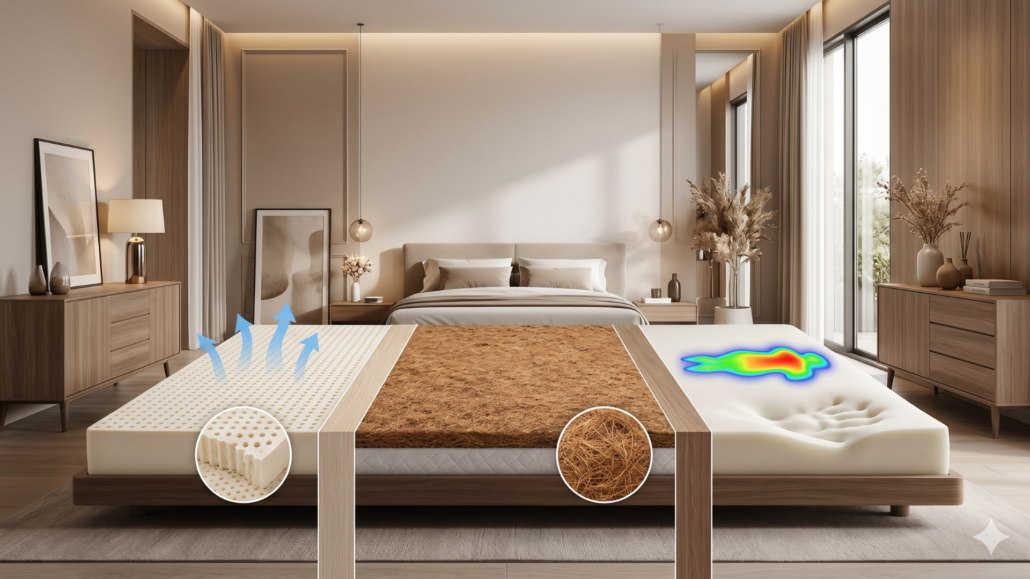
Latex Mattresses: Latex mattresses are renowned for their exceptional comfort and durability. They are available in two main forms: natural latex, derived from rubber trees, and synthetic latex, a petroleum-based product. Natural latex is often preferred for its eco-friendliness and hypoallergenic properties. Latex mattresses offer a unique buoyant feel, providing excellent support while conforming to the body’s curves. They are known for their responsiveness, meaning they quickly return to their original shape when pressure is removed. This makes them a great choice for those who toss and turn.
Coir Mattresses: Coir mattresses, primarily popular in warmer climates and eco-conscious homes, are made from natural coconut coir fibers. These fibers are often treated and bonded with latex to create a more resilient and comfortable sleep surface. The inherent nature of coir makes these mattresses firm, breathable, and highly durable. Their open cell structure promotes excellent air circulation, making them a fantastic option for hot sleepers. Coir mattresses are often hailed for their natural properties and their ability to provide firm, even support.
Head-to-Head: Latex vs Coir vs Memory Foam for Comfort & Support
Memory Foam Mattresses: Memory foam, developed by NASA, is celebrated for its ability to contour precisely to the body. This viscoelastic material responds to heat and pressure, softening and molding around your unique shape, offering unparalleled pressure relief. It’s known for its ‘hug’ feel and excellent motion isolation, meaning you won’t feel your partner’s movements. While early memory foam had issues with heat retention, modern advancements have led to various cooling technologies like gel-infused foam and open-cell structures to mitigate this.
Head-to-Head: Latex vs Coir vs Memory Foam for Comfort & Support
When evaluating latex vs coir vs memory foam mattress for comfort and support, each type presents a distinct sleeping experience. Understanding these differences is key to choosing your ideal mattress.
Comfort Profile:
Latex: Offers a responsive, buoyant, and slightly springy feel. It provides a generalized contour that supports the body without a deep sink. Often described as sleeping ‘on’ the mattress rather than ‘in’ it.
Coir: Known for its firm, sturdy feel. It provides a very stable and even sleeping surface, ideal for those who prefer minimal give. There’s no contouring with coir; it’s robust support.
Memory Foam: Delivers a deep, conforming ‘hug’ that cradles the body. It slowly molds to your shape, relieving pressure points. You feel more ‘in’ the mattress.
Finding Your Perfect Match: Best Mattress for Specific Sleepers and Conditions
Support & Spinal Alignment:
Latex: Excellent for spinal alignment, providing consistent support across the entire body. Its natural elasticity helps maintain good posture throughout the night.
Coir: Provides very firm, unyielding support. This can be beneficial for those who need a rigid surface for spinal alignment, although some might find it too hard.
Memory Foam: Excels at individualized support, adapting to the body’s unique curves to properly align the spine and reduce pressure points.
Motion Isolation:
Latex: Good to excellent motion isolation, especially for natural latex. It absorbs movement well, but not as completely as memory foam.
Coir: Moderate motion isolation. Due to its firm nature, it can transfer some movement.
Memory Foam: Superior motion isolation. It absorbs virtually all movement, making it an excellent choice for couples.
Finding Your Perfect Match: Best Mattress for Specific Sleepers and Conditions
Your individual needs significantly impact which mattress — latex vs coir vs memory foam mattress — will be best for you.
Making an Informed Decision: Key Factors When Buying a Mattress
For Back Pain Sufferers:
Latex: Often recommended for back pain due to its balanced support and pressure relief. It keeps the spine aligned while cushioning joints.
Coir: Can be suitable for those who prefer a very firm surface for back support, but might be too hard for some.
Memory Foam: Highly effective for back pain as it conforms to the body, distributing weight evenly and reducing pressure on the spine and joints.
For Hot Sleepers:
Coir: The clear winner. Its natural fibrous structure ensures maximum airflow, making it exceptionally breathable and cool.
Latex: Generally breathable, especially open-cell or pin-cored natural latex. It’s cooler than traditional memory foam but not as cool as coir.
Memory Foam: Traditional memory foam can retain heat. However, modern gel-infused or open-cell memory foams offer improved cooling.
For Allergy Sufferers:
Natural Latex: Naturally hypoallergenic, dust mite resistant, and antimicrobial, making it an excellent choice for allergy sufferers.
Coir: Generally hypoallergenic and resistant to dust mites and mold due to its natural properties and breathability.
Memory Foam: Densely constructed, which resists dust mites and allergens. However, some sensitive individuals might react to the off-gassing smell from new memory foam.
Making an Informed Decision: Key Factors When Buying a Mattress
Which Mattress Reigns Supreme: Indian Climate, Back Pain, and Durability
Beyond just the material choice, several factors should guide your decision in the latex vs coir vs memory foam mattress debate.
Budget: Coir mattresses are often the most affordable, followed by memory foam (with a wide range based on features), and natural latex typically being the most expensive due to its natural origin and durability.
Durability & Longevity: Natural latex mattresses are known for their exceptional durability, often lasting 15-20 years. Coir mattresses are also very durable (8-10 years), while memory foam mattresses typically last 7-10 years, depending on quality.
Environmental Impact: Natural latex and coir are excellent eco-friendly choices. Synthetic latex and some memory foams have a larger carbon footprint, though many manufacturers are now focusing on greener production methods.
Firmness Preferences: This is highly personal. Test mattresses in person if possible. Latex offers a range from medium-soft to firm. Coir is inherently firm. Memory foam can range from plush to firm, with the ‘feel’ being consistent.
Weight of Sleeper: Heavier individuals often prefer the robust support of firm latex or coir, or a high-density memory foam to prevent excessive sinking.
Which Mattress Reigns Supreme: Indian Climate, Back Pain, and Durability
Considering specific regional and health concerns adds another layer to the latex vs coir vs memory foam mattress comparison.
Latex, Coir, or Memory Foam: The Ultimate Verdict for Your Best Sleep
Indian Climates: For the often hot and humid Indian climate, coir mattresses are a strong contender due to their superior breathability and cooling properties. Latex also performs well, especially aerated natural latex. Traditional memory foam might be less ideal unless it features advanced cooling technologies.
Back Pain Relief: All three can provide relief, but the best depends on the individual’s preference for firmness and contouring. Memory foam and latex are often highly recommended for their pressure-relieving and conforming capabilities, which support spinal alignment. For those who need a very firm surface, coir can be beneficial.
Durability Concerns: If longevity is a top priority, natural latex mattresses are hard to beat. Their inherent resilience ensures they maintain their shape and support for many years, offering excellent value over their lifespan.
Latex, Coir, or Memory Foam: The Ultimate Verdict for Your Best Sleep
Ultimately, the choice between a latex vs coir vs memory foam mattress boils down to a combination of personal preferences, budget, and specific needs. If you prioritize natural materials, eco-friendliness, buoyant support, and exceptional durability, a latex mattress is an outstanding choice. It’s often recommended for those with allergies and back pain who don’t want a deep ‘hug’ feeling. For those living in hot climates, seeking a firm, breathable, and affordable natural option, the coir mattress stands out. And if deep pressure relief, superior motion isolation, and a body-hugging feel are your top concerns, especially for chronic pain, then a high-quality memory foam mattress will likely provide the best sleep experience. We encourage you to weigh these factors carefully to make the best decision for your unique sleep profile, ensuring restful and rejuvenating nights.
Frequently Asked Questions About Mattress Types
Frequently Asked Questions
Which mattress is best for back pain: latex, coir, or memory foam?
For back pain, both latex and memory foam are highly recommended. Memory foam excels at contouring to relieve pressure points, while latex offers a buoyant yet supportive feel that keeps the spine aligned. Coir can be suitable if you prefer a very firm surface, but it offers less contouring.
Which mattress type is most breathable and best for hot sleepers?
Coir mattresses are the most breathable due to their natural fiber construction, allowing for maximum airflow. Latex mattresses, especially natural pin-cored versions, are also very breathable. Traditional memory foam can retain heat, but newer gel-infused or open-cell varieties offer improved cooling.
Are latex mattresses truly natural and eco-friendly?
Natural latex mattresses, made from the sap of rubber trees, are indeed highly natural, eco-friendly, biodegradable, and often hypoallergenic. Look for certifications like GOLS (Global Organic Latex Standard) to ensure genuine natural latex. Synthetic latex exists, so always check the product description.
How long do latex, coir, and memory foam mattresses typically last?
Natural latex mattresses are the most durable, usually lasting 15-20 years. Coir mattresses typically last 8-10 years. Memory foam mattresses generally have a lifespan of 7-10 years, depending on the quality and density of the foam.
What is the primary difference in ‘feel’ between latex and memory foam?
Latex offers a responsive, buoyant feel where you sleep ‘on’ the mattress. It springs back quickly. Memory foam, conversely, provides a deep, conforming ‘hug’ where you sink ‘into’ the mattress and it slowly molds to your body, retaining its shape for a bit.


Leave a Reply
Want to join the discussion?Feel free to contribute!